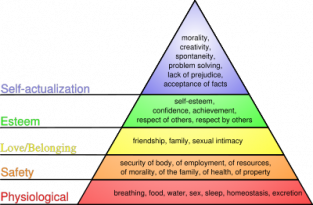
In 1943, Abraham Maslow made one of the biggest contributions of the century to the study of human psychology. He created and published what is commonly known as 'The Human Hierarchy of Needs'. This post will explain the hierarchy (heavily citing Wikipedia). The next posts will apply this old-but-still-relevant pyramid to our everyday lives and, especially, to entrepreneurs seeking to develop their products.
I hope, through this series, to demonstrate the hidden genius and the far-reaching consequences of this pyramid in all aspects of our lives.
Maslow postulated that needs are arranged in a hierarchy in terms of their potency. Although all needs are instinctive, some are more powerful than others. The lower the need is in the pyramid, the more powerful it is. The higher the need is in the pyramid, the weaker and more distinctly human it is. The lower, or basic, needs on the pyramid are similar to those possessed by non-human animals, but only humans possess the higher needs.
The base of the pyramid is formed by the physiological needs, including the biological requirements for food, water, air, and sleep. If some needs are not fulfilled, a human's physiological needs take the highest priority. Physiological needs can control thoughts and behaviors, and can cause people to feel sickness, pain, and discomfort.
Once the physiological needs are met, an individual can concentrate on the second level, the need for safety and security. Included here are the needs for structure, order, security, and predictability.
The third level is the need for love and belonging. Included here are the needs for friends and companions, a supportive family, identification with a group, and an intimate relationship. In the absence of these elements, many people become susceptible to loneliness, social anxiety, and depression.
The fourth level is the esteem needs. This group of needs requires both recognition from other people that results in feelings of prestige, acceptance, and status, and self-esteem that results in feelings of adequacy, competence, and confidence. Lack of satisfaction of the esteem needs results in discouragement and feelings of inferiority.
Finally, self-actualization sits at the apex of the original pyramid. More on that last elusive level in the next post.
Five years ago, I attended one of my first local EO learning events in Montreal. It was a speaker who demonstrated to us the power of managing a company by simple key metrics put in a simple format.
I forget who the speaker was and I was only able to jot down a couple of the formulas he used at that time. I was, however, sensitized enough to start building my own simple financial dashboard. This is my tool of choice when when I audit the financial part of a corporate strategy.
Presentation format :
- Magic number : Formula to get the number
o Suggested acceptable range of the magic number (subjective according to your situation, but most are based on industry best practices)
1. Liquidity ratios : ability to pay bills and availability of liquidity for new activity
- Current ratio : Current Assets / Current Liabilities
o 2 : 1
- Acid Test Ratio : (Cash + Accounts Receivable) / Current Liabilities
o 1 : 1
- Debt/Equity Ratio : Total Liabilities / Owners (Stock) Equity
o Lower than 2:1
- Times Interest Earned : Net income before Interest & Taxes / Interest Expense
o 5:1
2. Efficiency ratios : ability to deliver optimized internal process efficiencies -Net Income ratio : Net Income / Sales
o More than 10 cents on the dollar
- Gross margin ratio : Gross Margin / Sales
o Gross margin = Sales – Cost of sales
- Asset Turnover Rate : Sales / Total Assets
- Accounts Receivable Turnover : Sales / Average Accounts Receivable
o Lower than 60 days
- Number of Days Sales in Receivables : Average Accounts Receivable / (Annual Sales / 360)
o Any number above 30 indicates past due accounts
- Inventory Turnover : Cost of Sales / Average Inventory
o 25 c for each 1$ held in inventory
3. Equity Ratios : ability to deliver optimized shareholder and stakeholder value
- Return on assets : Net Income / Total Assets
o More than 10%
- Return on equity : Net Income / Stockholders Equity
- Earnings per share : Earnings after taxes / Number of Shares Outstanding
- Price/Earnings Ratio : Price / Earnings per share
- P/E Reciprocal : Earnings per share / Price
- Total Market Cap : Number of Outstanding Shares x Market Price per Share
I often coach entrepreneurs when they start their businesses and, in doing so, get to the core of 'why' they want to go out on their own. I love it when dreams of boatloads of money surface.
And then I ask THE question : 'How much is enough ?' I continue : 'If I give you 1 million dollars right now, would you be happy ?' 'How about 5 million ? 10 million ? (etc)' The conversation quickly turns to how much is needed to live well, what living well means and what the real priorities in life are.
Somewhere during the entrepreneur's soul-searching, I take out a fantastic study that was done many times and taken up by a University of Wisconsin group. There are similar stats on the web, this one comes from the good people at www.100people.org.
Miniature Earth have also made a video with older stats but still very poignant.
It's enough to make the entrepreneur reflect on his true priorities and just how much is really enough.
Important note : I'm certainly not coaching entrepreneurs to NOT make money. I am simply getting them to reflect about their situation on a global scale and realize just how blessed they already are. I also try to bring the entrepreneur to develop other reasons than money to start a business.
IF THE WORLD WERE 100 PEOPLE:
Gender
50 would be female
50 would be male
Age
20 would be 0-14
67 would be 15-64
14 would be 65 and older
Geography
5 would be from North America
9 would be from Latin America & the Caribbean
12 would be from Europe
61 would be from Asia
13 would be from Africa
Religion
31 would be Christian
21 would be Muslim
14 would be Hindu
6 would be Buddhist
12 would believe in other religions
16 would not be religious or identify themselves
as being aligned with a particular faith
First Language
17 would speak Chinese
8 would speak Hindustani
8 would speak English
7 would speak Spanish
4 would speak Arabic
4 would speak Russian
3 would speak Bengali
2 would speak Malay-Indonesian
2 would speak French
45 would speak other languages
Overall Literacy
82 would be able to read and write
18 would not
Literacy by Gender
87 males would be able to read and write
13 males would not be able to read and write
77 females would be able to read and write
23 females would not be able to read and write
Education
76 males would have a primary school education
72 females would have a primary school education
66 males would have a secondary school education
63 females would have a secondary school education
1 would have a college education
Urban/Rural
47 would be urban dwellers
53 would be rural dwellers
Drinking Water
83 would have access to safe drinking water
17 would use unimproved water
Food
17 would be undernourished
Infectious Disease
<1% would have HIV/AIDS
<1%would have tuberculosis
Poverty
53 would live on less than 2USD per day
50 would live in poverty
Electricity
69 would have electricity
31 would not
Technology
34 would be cell phone subscribers
17 would own a computer
1 would be be active internet users
I realize that with a title like that, I need to back it up with solid facts and credible evidence. No problem.
There is one strategy and management planning tool that I have used in all my past and am using in my current ventures. It's a two-pager developed by Verne Harnish, a friend of mine who trains high-growth companies. He is also the highly sought-after author of 'Mastering the Rockefeller Habits'. Verne has spent the better part of his career training companies that are (or who want to become) gazelles - a term he uses for a company that has grown by 20% annually for the last 5 years.
He has brought together in a succinct format all the necessary elements of strategic planning. This is a tool to plan and communicate where you, where you are going and how you are going to get there.
Here is the link to downloading his free forms and strategic planning material.
It's gold.
I often ask the question to my university students : "'Why do you want to be entrepreneurs, to start your business ?"
We then go through the usual more money, more power, more glory and more pleasure arguments. And then, inevitably, one student says : "I want to be my own boss".
I love that answer, mostly because I get to burst a well known bubble.
The entrepreneur is not his own boss. At least not in the sense the students usually means it. We have to be able to manage a dozen different relationships at one time and make sure EVERY single one is a happy one. It is an absolute necessity for the entrepreneur to maintain healthy ties to the actors in his environment. Failure to do so results in ... well... corporate failure.
Here are the actors in the entrepreneur's world that are actually his collective bosses :
- Suppliers
- Clients
- Associates
- Employees
- Bankers
- Investors
- Shareholders / Stakeholders
- Boards
- Unions
- Business partners
- Government
- and most importantly, the family.
That sound you hear is from entrepreneurs-to-be's bubble bursting.