|
There are many 'plans' that seek to help manage a business. The business plan, themarketing plan, the strategic plan, the project management plan, etc. All tools to that use different techniques to answer the three fundamental questions: - Who am I ? and Where am I today ? - Where am I going ? - How am I going to get there ? I got tired of over-used business plans that nobody reads. Tired of marketing plans based on wishful thinking. Tired of task-based project management plans that narrow-mindedly didn't take into account the company's vision. Tired of strategic plans done during plush retreats with a select few that were disconnected with their corporate reality. Throughout my career, I have looked to integrate those 'plans' into one comprehensible, integrated, 1-page model. It's an ambitious idea : develop a model to unite all models. Particularly, I focus on the inter-relationships between the different parts of the model. How does one part of a plan affect the others ? After years of research and vulgarising exercises, I give you the (continually developed) Integrated Strategy Model (ISM). This model has been tried and tested with many client cases, refined through my experience. I have extensively documented the description, the process and the how-to of each box as well as the reasoning behind each link. It will be updated and tweaked. The current state is : Version : 1.0 Released : August 2012 Enjoy it, use it at will, discuss it with me, and contact me if you would like help to apply it to your business. 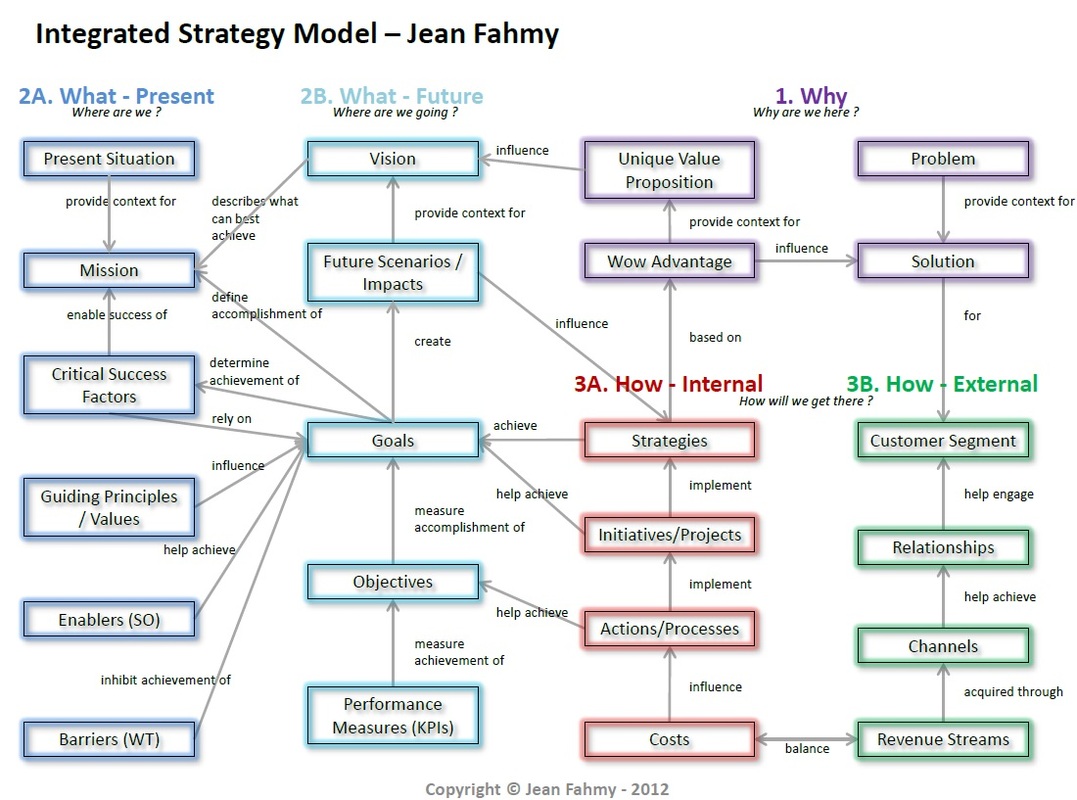 Download it here (pdf)
It has always astonished me that in the Web and the IT world, one of the biggest hurdles remains some people's strong aversion to change.
Ariane de Bonvoisin wrote a book about personal change and established 9 principles to help modify our view of it. These 9 can be applied on a personal level and on a corporate level as well. They are here, but can be read below. Principle 1: People who successfully navigate change have positive beliefs. Your biggest need right now is to develop new beliefs: about yourself, about this change, and about life in general. Nothing will have a bigger impact on the way you move through change. Principle 2: People who successfully navigate change know that change always brings something positive into their lives. Every change has a gift associated with it. While it’s natural to find change hard it’s important to remember that there are two sides to every coin and that something positive will always come. This is by far the most important belief to have during the first thirty days of change. Principle 3: People who successfully navigate change know they are resilient, strong, and capable of getting through anything. You are much stronger, much smarter, and much more intuitive than you have ever been told. You are more resilient and more powerful. Once you truly know and believe this, you will be able to get through any change- even the hardest one you can imagine. Principle 4: People who successfully navigate change know that every challenging emotion they feel is not going to stop them and will guide them to positive emotions that help them feel better. Negative emotions can stall us, making change harder, while the positive ones can help us move through a change in a simpler, quicker, and more conscious way. Principle 5: People who successfully navigate change know that the quicker they accept the change, the less pain and hardship they will feel. Let go of the idea of how life should be. Principle 6: People who successfully navigate change use empowering questions and words, think better thoughts, and express their feelings. At your most stuck point, if you can speak with different words, think a slightly better thought, and get in touch with how you are feeling, you can become unstuck in a matter of minutes. Principle 7: People who successfully navigate change know they are connected to something bigger than themselves. When everything around you is changing, look for the part of you that doesn't change. The part that is calm, centered and always there. Principle 8: People who successfully navigate change are not alone; they surround themselves with people who can help, who have the right beliefs and skills. And they create an environment that supports their change. One of our biggest flaws as human beings is that we keep thinking we are alone. Whatever the situation, there is always, always someone who can help. Principle 9: People who successfully navigate change take action. They have a plan and know how to take care of themselves. Actions come in many forms. Some are big and obvious; some are so small you may think they are irrelevant. But any good action you take is a choice to move forward. From TED comes this video about leadership and it's brilliant parallel with conducting an orchestra. From the youtube description 'An orchestra conductor faces the ultimate leadership challenge: creating perfect harmony without saying a word. In this charming talk, Itay Talgam demonstrates the unique styles of six great 20th-century conductors, illustrating crucial lessons for all leaders.'
It runs the gamut of leadership styles and how they all can be seen in conducting orchestras. The video also makes us question our own leadership style: - Does leading necessarily require control ? - Do we tell our own stories or help others tell their story ? Can others develop their skill under our leadership or can they just apply it ? - Is there a purpose in our leadership or is it a technique we are applying ? - Can we create the processes and the structure to allow others feel and be free to express themselves ? ... And what I believe is the most important question : Are we having fun ? When Guy Laliberté, founder of the Cirque Du Soleil, met with the remaining Beatles to pitch the concept of 'Love' - a show that would integrate their songs in a most creative format - he used only three words. After years of trying to get his idea through, now sitting in front of them, he had the chance of the lifetime to convince them. The normal reaction would have been to elaborate fantastic concepts to wow The Beatles. But he just used three words that were powerful enough to move them: Let's have fun. The Fun Theory is a web site that tries to get ordinary people change habits by making the alternative habit a fun one. Here is an example of getting people to use the stairs instead of the escalator. Fun. It's the unique value proposition. Setting: A boat docked in Ferragudo, a tiny fishing village in the Algarve region in the South of Portugal. Every once in a while, I come across a video that makes me say: 'wow, that's so true' and 'where were you all my life?'. Whether one is an entrepreneur or an employee, whether we need to satisfy our boss, our client, our supplier, our employee or our spouse, managing expectations is the single most important key. Countless expensive systems and processes are developed to ensure that we define the promise, we accomplish the promise and we demonstrate the return on the promise.
Competition is a fascinating thing. It brings out the best and worst of us. It stimulates and forces us to be creative. And, in whatever form it is found, whether in a battlefield or in a game of cards, parties seek the same goal : to win. |
AuthorEverything you never wanted to know about the author is on this web site : www.jeanfahmy.com Categories
All
Archives
December 2014
 |
 RSS Feed